Our quest to identify the second greatest Mormon baseball player brings us to the pitchers. I'm proud to say that this is a pretty good crop. There seem to be more very good Mormon pitchers than Mormon position players, and if anyone has a theory as to why I'd like to hear it. But this analysis comes down to five pitchers: Roy Halladay, Jack Morris, Dennis Eckersley, Bruce Hurst, and Vernon Law.
I'll just note here that my search for the second greatest Mormon baseball players is not contingent on church activity or faithfulness. First, I have no way of knowing and second it's not my place to make those judgment calls anyway. Eckersley, for instance, is only known to have been active for a few years as a youth and has had some well publicized trials and struggles and as far as I can tell does not identify as a Mormon, but he was baptized and so we consider him. I'm not sure if this is the best way to do it or not, but I'm a big-tent Mormon kind of guy and so we push on.
This is going to get a little long so let me just dispense with the suspense right now for those that don't want to read the whole thing: Roy Halladay, with even a partially completed career, is the greatest Mormon pitcher of all time and by the time it's all said and done it won't even be close. There, you know how it ends, now lets enjoy the journey, in alphabetical order.
Showing posts with label sports. Show all posts
Showing posts with label sports. Show all posts
Monday, May 23, 2011


Wednesday, May 18, 2011
Second Greatest Mormon Baseball Player (Non-Pitcher Division)
If Harmon Killebrew is the obvious greatest Mormon baseball player of all time, and I think he is, then it behooves us to identify the second greatest Mormon baseball player of all time. This is a bit of a closer call, so we'll break it down into two posts with this first one focusing on everyday players and the next one on pitchers.
This really comes down to Dale Murphy and Jeff Kent, though we'll throw Wally Joyner in there because he was pretty good, as well. We'll start with a couple WAR chart comparisons from Fangraphs and then break 'em down individually.
This really comes down to Dale Murphy and Jeff Kent, though we'll throw Wally Joyner in there because he was pretty good, as well. We'll start with a couple WAR chart comparisons from Fangraphs and then break 'em down individually.
Tuesday, May 17, 2011
Harmon Killebrew, Greatest Mormon Baseball Player, Dies

They called him Killer because his name was Killebrew but his personality was the exact opposite. There are hundreds of stories out there about how kind and gentle and approachable Killer was. But at the plate the man lived up to the name. As the incomparable Joe Posnanski points out, he was inhumanly strong and hit home runs at a pace greater than Mickey Mantle, Ted Williams, and Sammy Sosa. He was born to rake.
In his career he hit 573 home runs, including eight 40 homer seasons (and one 39 homer season), which is good for 11th all time. Though the list is now polluted with steroid users, at the time he retired he was
There has always been a rumor that Killer was the model for the MLB logo, though it is not entirely clear. You can read up about it here. Killebrew always maintained that it was him, and the man that supposedly designed it maintained that was just a composite of a lot of different batters. In any case, he is an iconic figure in baseball, the face of Minnesota Twins, and, in my opinion, one of the mythical "inner circle" Hall of Famers.
Dale Murphy was a pretty great centerfielder and has a good case for the Hall of Fame, Jacoby Ellsbury is a Red Sox which automatically makes him capital-G Great, Jeff Kent is one of the great offensive second basemen of all time, Bryce Harper is quickly gaining legend as perhaps the greatest prospect ever, and when all is said and done, Roy Halladay may end up taking the title of greatest Mormon baseball player of all time from Killebrew and leave Killer just as the greatest Mormon hitter of all time, but for now Harmon Killebrew stands alone, and baseball and Mormons have lost a great one.
Tuesday, July 20, 2010
Lessons to Learn from The World Cup
Beginning in 1930 and played (almost) every 4 years since then, the World Cup is the Beautiful Game’s ultimate tournament. Having spent the vast majority of my life participating in this sport, it goes without saying that I find this a magical time.
I love the athleticism of 22 players on the pitch. In enjoy the passing, the shots, the saves, the traps, the runs. All of it. For anyone that has spent a significant amount of time involved in a sport, this level of fascination and appreciation is totally understandable. But my captivation with soccer (or football for the purist) goes deeper than just awe of the physical talents demonstrated. I think there is some interesting social commentary in and around The Game.
I believe that you can start to tell how dedicated a person is to something based on their response to success and failure. While enthusiasm and jubilee are evident after success, discouragement and despair are just as apparent after failure. Obviously there is a healthy level of despair (see below), but if someone doesn’t feel a noticeable amount of frustration or sadness when a shot goes wide; if you don’t feel a little depressed when you are down by a goal or two and the whistle blows at the end of 90 minutes; then I would argue that the game didn’t really mean all that much to you.
A poignant example of this dichotomy was seen in the Round of 16 match between the US and Ghana. The United States made it through the first stage ranked number 1 in their group – more a result of fleeting moments of brilliance than solid, consistent play. Ghana come through ranked number 2 in their group, and while their team didn’t boast huge superstars, they had been playing hard-nose, over-achieving ball. Both of these teams are trying to shake different stigmas: the US that our nation doesn’t really care that much about soccer; Ghana that an African team could master the Beautiful Game and truly compete on an international level. It’s also important to note that Ghana was the last of the African teams, and as such, had the backing of an entire continent.
An entertaining game that went to overtime, and effectively ended when the Ghanian star Gyan scored on great left-footed shot. Perhaps I am overly cliché, but both teams “gave it all they could” and their effort was obvious when the final whistle polarized each team’s emotions. Ghana won and was ecstatic. The US lost and was devastated.

 Vince Lambardi’s famous misquote indeed summarizes the drive to succeed; “Winning isn’t everything. The will to win is everything.” I believe that the desire to succeed should permeate our existence. That doesn’t mean “win at all costs”, that means that we put everything we’ve got into the tasks we undertake. Be it family, or work, or callings. When something in one of these charges fails, we should feel a significant level of dismay and disappointment. Likewise, when something succeeds, we should feel celebratory.

Naturally one question to arise is what to do when we fail. Do we succumb to the dismay and depression that result from failure?
Turning back to the World Cup. Germany and Uruguay both lost semi-final matches to their respective opponents. If you watch the games, or look at images of the players of these losing teams, it is obvious how crushing the losses were.
Both teams had come exceptionally close to the cup, only to miss the chance to participate in the final. The “consolation” match for third place between Germany and Uruguay started as one might expect – two teams that felt frustrated and depressed. The beginning of the game didn’t swell with the normal excitement or anticipation of other matches. In fact, it almost seemed to me that the teams would rather be on a plane headed home, than playing another match. However, not long into the game, everything changed. I can’t put my finger on the exact moment, but sometime in that first half both teams seem to forget about their recent pain, and started paying attention to the task at hand. In my opinion, the match turned out to be one of the most entertaining of the entire tournament. The skills of individual players and composite teams were astounding. The desire to win was rekindled, and the result was a courageous attempt to excel. Only when the players dismissed the agony of recent defeats were they able to meet their potential.

Likewise in life. Anything worth doing is worth our unbridled effort (D&C 4). Success and failure are transient. Failure should not consume us, but only be the motivation to improve.
I could go on about a number of other things, like the traditional exchanging of jerseys at the end of a game, or the professionalism of stopping play when a player is (really) injured. But I’ll stop here.
There is so much joy in the journey. The highs and lows of a game are what make it interesting. Without missed shots, saves, goals, and all the rest, it would just be a bunch of people aimlessly jogging around with their socks pulled high.
I love the athleticism of 22 players on the pitch. In enjoy the passing, the shots, the saves, the traps, the runs. All of it. For anyone that has spent a significant amount of time involved in a sport, this level of fascination and appreciation is totally understandable. But my captivation with soccer (or football for the purist) goes deeper than just awe of the physical talents demonstrated. I think there is some interesting social commentary in and around The Game.
I believe that you can start to tell how dedicated a person is to something based on their response to success and failure. While enthusiasm and jubilee are evident after success, discouragement and despair are just as apparent after failure. Obviously there is a healthy level of despair (see below), but if someone doesn’t feel a noticeable amount of frustration or sadness when a shot goes wide; if you don’t feel a little depressed when you are down by a goal or two and the whistle blows at the end of 90 minutes; then I would argue that the game didn’t really mean all that much to you.
A poignant example of this dichotomy was seen in the Round of 16 match between the US and Ghana. The United States made it through the first stage ranked number 1 in their group – more a result of fleeting moments of brilliance than solid, consistent play. Ghana come through ranked number 2 in their group, and while their team didn’t boast huge superstars, they had been playing hard-nose, over-achieving ball. Both of these teams are trying to shake different stigmas: the US that our nation doesn’t really care that much about soccer; Ghana that an African team could master the Beautiful Game and truly compete on an international level. It’s also important to note that Ghana was the last of the African teams, and as such, had the backing of an entire continent.
An entertaining game that went to overtime, and effectively ended when the Ghanian star Gyan scored on great left-footed shot. Perhaps I am overly cliché, but both teams “gave it all they could” and their effort was obvious when the final whistle polarized each team’s emotions. Ghana won and was ecstatic. The US lost and was devastated.

 Vince Lambardi’s famous misquote indeed summarizes the drive to succeed; “Winning isn’t everything. The will to win is everything.” I believe that the desire to succeed should permeate our existence. That doesn’t mean “win at all costs”, that means that we put everything we’ve got into the tasks we undertake. Be it family, or work, or callings. When something in one of these charges fails, we should feel a significant level of dismay and disappointment. Likewise, when something succeeds, we should feel celebratory.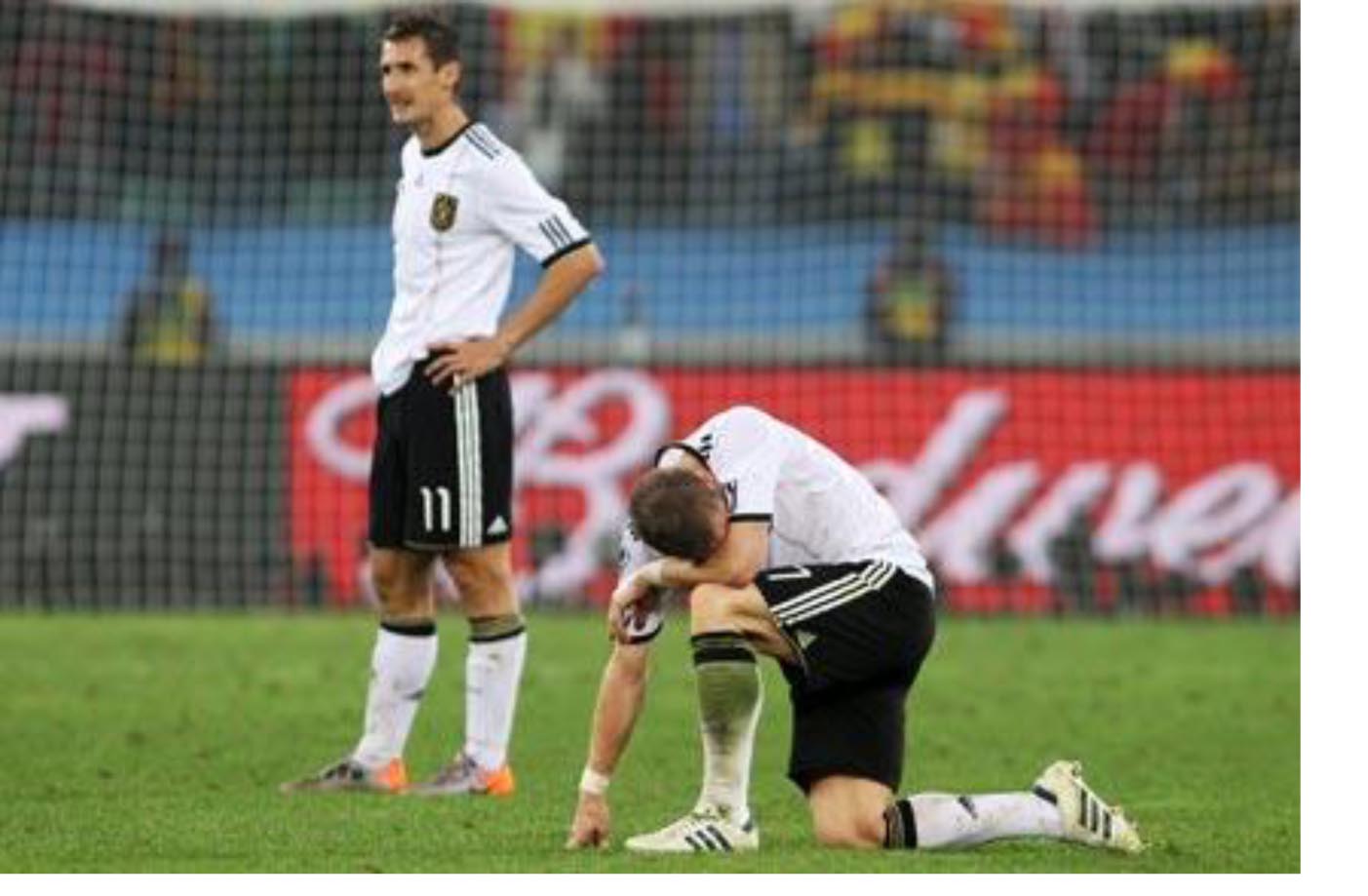
Naturally one question to arise is what to do when we fail. Do we succumb to the dismay and depression that result from failure?
Turning back to the World Cup. Germany and Uruguay both lost semi-final matches to their respective opponents. If you watch the games, or look at images of the players of these losing teams, it is obvious how crushing the losses were.
Both teams had come exceptionally close to the cup, only to miss the chance to participate in the final. The “consolation” match for third place between Germany and Uruguay started as one might expect – two teams that felt frustrated and depressed. The beginning of the game didn’t swell with the normal excitement or anticipation of other matches. In fact, it almost seemed to me that the teams would rather be on a plane headed home, than playing another match. However, not long into the game, everything changed. I can’t put my finger on the exact moment, but sometime in that first half both teams seem to forget about their recent pain, and started paying attention to the task at hand. In my opinion, the match turned out to be one of the most entertaining of the entire tournament. The skills of individual players and composite teams were astounding. The desire to win was rekindled, and the result was a courageous attempt to excel. Only when the players dismissed the agony of recent defeats were they able to meet their potential.

Likewise in life. Anything worth doing is worth our unbridled effort (D&C 4). Success and failure are transient. Failure should not consume us, but only be the motivation to improve.
I could go on about a number of other things, like the traditional exchanging of jerseys at the end of a game, or the professionalism of stopping play when a player is (really) injured. But I’ll stop here.
There is so much joy in the journey. The highs and lows of a game are what make it interesting. Without missed shots, saves, goals, and all the rest, it would just be a bunch of people aimlessly jogging around with their socks pulled high.
Tuesday, May 12, 2009
On Manny and Steroids and Human Nature
There is no more over-written-about subject on the internets than steroids in baseball. I have tried to remain aloof. I have tried to reserve judgment. I have more or less navigated my way through the stages of grief quietly and introspectively. But now it has hit a little too close to home and I must make my completely unoriginal thoughts on the matter known.
It recently became known that Manny Ramirez, currently on the Dodgers, formerly of the Red Sox, has been suspended for 50 games, or about one-third of the season, for taking performance enhancing drugs. The offending substance was hCG, which is, and I find this amusing, a female fertility drug that steroid users inject at the end of a cycle of steroids to get their bodies back to normal (I think the term of art is, "cycling out").
Manny's excuse is that it was prescribed, just an innocent mistake. We've heard that one before. Some other reactions to getting caught with steroids or, more generally, performance enhancing drugs (PEDs) are:
Anyway, like I said, this newest PED revelation about Manny hit a little close to home. I am someone who loves baseball, and I love the Red Sox. I am too old for this, I know, but it is what it is. My wife swears I came to tears when the Sox finally won the World Series in 2004 after an 86-year drought, and again when I bought the complete DVD's and watched the moment again. I say hogwash, but she is adamant. I almost named my dog Manny a few years ago to honor the greatest right-handed hitter of the generation who propelled the Sox to two World Series championships. And he's a druggy.
I was initially surprised and saddened. But that wore away pretty quick. Nothing should surprise us anymore in this regard. And then I remembered this take on the situation from baseball thinker extraordinaire, Bill James:
Another factor to consider is that advances in medicine and pharmaceutics has blurred the line between what is cheating and what is therapeutic. We can now remove ligaments from our ankles and insert them in our elbows to treat elbow injuries (the so-called Tommy John Surgery). We have medication that treats illness and allergies far better than in the past. We have corrective laser surgery for our eyes to make us see better.
Of course, we can see a distinction between these advances which are deemed safe and legal and corrective, as opposed to PEDs which fewer players are presumably willing to take because of long-term health risks and illegality, and which put the person on an unhuman level of ability and strength that the other treatments don't, but it really isn't so cut and dry. Especially in the heat of the moment with millions of dollars on the table.
So I don't end up angry, or sad, or give up the game completely. I try to remember how I felt when this happened. How I feel when I play catch in the backyard with my boy or watch one of his little league games. I try to remember that these are all still just humans and that, like the rest of the population, some are cheaters, some are jerks, some are idiots, some are genuine, some are honorable, and some are just completely normal except for the fact that they can throw a ball 95 mph and nail a precise target. Or hit a round ball coming in at 95 mph with a round bat, 400 feet and make tens of thousands of people cheer and forget about life for a moment.
Knowing this almost makes the game seem more real, in a finding-out-there-is-no-Santa kind of way. I feel a little nostalgic for the cleaner past, but more human knowing the truth.
It recently became known that Manny Ramirez, currently on the Dodgers, formerly of the Red Sox, has been suspended for 50 games, or about one-third of the season, for taking performance enhancing drugs. The offending substance was hCG, which is, and I find this amusing, a female fertility drug that steroid users inject at the end of a cycle of steroids to get their bodies back to normal (I think the term of art is, "cycling out").
Manny's excuse is that it was prescribed, just an innocent mistake. We've heard that one before. Some other reactions to getting caught with steroids or, more generally, performance enhancing drugs (PEDs) are:
- Complete silence in the face of overwhelming evidence;
- Testifying before Congress, untruthfully, while wagging an indignant finger, that you have never, ever taken steroids;
- Feigning like you don't speak English;
- Tromping around in a hissy denying it and filing lawsuits against accusers even though the entire world -- seriously, everyone -- knows that you took steroids;
- Admitting you did it when you were young and stupid but, for real, just the once and I totally didn't like the way it made me feel;
- Admitting that you did it when you were young and stupid for a just a few years but you are over it now (until more evidence comes forth);
- And so on.
Anyway, like I said, this newest PED revelation about Manny hit a little close to home. I am someone who loves baseball, and I love the Red Sox. I am too old for this, I know, but it is what it is. My wife swears I came to tears when the Sox finally won the World Series in 2004 after an 86-year drought, and again when I bought the complete DVD's and watched the moment again. I say hogwash, but she is adamant. I almost named my dog Manny a few years ago to honor the greatest right-handed hitter of the generation who propelled the Sox to two World Series championships. And he's a druggy.
I was initially surprised and saddened. But that wore away pretty quick. Nothing should surprise us anymore in this regard. And then I remembered this take on the situation from baseball thinker extraordinaire, Bill James:
"You give me the opportunity to earn $22 million a year by taking steroids, I’ll shoot the pharmacist if I have to. I’m not saying it’s right. I’m not saying I shouldn’t be punished for shooting the pharmacist. I am saying it is self-righteous to pretend that I don’t have the same human failings that these guys do, and further, if you are insisting that you don’t have them, I don't believe you."
Another factor to consider is that advances in medicine and pharmaceutics has blurred the line between what is cheating and what is therapeutic. We can now remove ligaments from our ankles and insert them in our elbows to treat elbow injuries (the so-called Tommy John Surgery). We have medication that treats illness and allergies far better than in the past. We have corrective laser surgery for our eyes to make us see better.
Of course, we can see a distinction between these advances which are deemed safe and legal and corrective, as opposed to PEDs which fewer players are presumably willing to take because of long-term health risks and illegality, and which put the person on an unhuman level of ability and strength that the other treatments don't, but it really isn't so cut and dry. Especially in the heat of the moment with millions of dollars on the table.
So I don't end up angry, or sad, or give up the game completely. I try to remember how I felt when this happened. How I feel when I play catch in the backyard with my boy or watch one of his little league games. I try to remember that these are all still just humans and that, like the rest of the population, some are cheaters, some are jerks, some are idiots, some are genuine, some are honorable, and some are just completely normal except for the fact that they can throw a ball 95 mph and nail a precise target. Or hit a round ball coming in at 95 mph with a round bat, 400 feet and make tens of thousands of people cheer and forget about life for a moment.
Knowing this almost makes the game seem more real, in a finding-out-there-is-no-Santa kind of way. I feel a little nostalgic for the cleaner past, but more human knowing the truth.
Monday, April 6, 2009
The Rite of Opening Day
Let's take a break from our regularly scheduled political scrum to celebrate a national day of regeneration. In my own twisted mind I like to consider baseball's Opening Day as akin to the weekly sacrament. In both cases the regularly scheduled event is a way to brush off the unpleasantness of the past and look with new hope to the future. In the case of the sacrament we put an end to the previous week's sins and sadnesses and look forward with renewed hope and strength to the new week. In the case of Opening Day we put behind us the fact that the Red Sox did not win the previous World Series (or whatever other team you happen to follow, excluding the Phillies, of course) and the long, cold, baseball-less winter and look forward with renewed hope at the upcoming season. Is this a sacrilegious analogy? Perhaps, but aptness demands its expression.
Opening Day marks the beginning of spring and the end of winter. And for the next seven months baseball will be played every single day. You can no more hope to escape the influence of the game than you can the influence of the sun itself. Not only in the shear number of games played, but in its ubiquity in our culture. Think of the all the baseball phrases we use on a near daily basis: "Out of left (or right) field" for something unexpected, "Safe at home," "Hit a homerun" for doing something well, "Strike out" for failing to achieve a goal, "Three strikes" for giving a person three chances at anything, "Southpaw" for a lefthander, and so many more. The game is engrained in our national psyche and you have no choice but to embrace it.
Our nation has been celebrating Opening Day since around 1876. Opening day 2009 is just another chain in the link between the early game played by teams such as the Cleveland Spiders, the Detroit Wolverines, and the Providence Grays in the 1800's and the game that will assuredly be played in the afterlife in its celestial form (see: no steroids and Yankees go winless year-in year-out).
Opening Day marks the beginning of spring and the end of winter. And for the next seven months baseball will be played every single day. You can no more hope to escape the influence of the game than you can the influence of the sun itself. Not only in the shear number of games played, but in its ubiquity in our culture. Think of the all the baseball phrases we use on a near daily basis: "Out of left (or right) field" for something unexpected, "Safe at home," "Hit a homerun" for doing something well, "Strike out" for failing to achieve a goal, "Three strikes" for giving a person three chances at anything, "Southpaw" for a lefthander, and so many more. The game is engrained in our national psyche and you have no choice but to embrace it.
Our nation has been celebrating Opening Day since around 1876. Opening day 2009 is just another chain in the link between the early game played by teams such as the Cleveland Spiders, the Detroit Wolverines, and the Providence Grays in the 1800's and the game that will assuredly be played in the afterlife in its celestial form (see: no steroids and Yankees go winless year-in year-out).
Saturday, January 3, 2009
A Utah Man Am I
I have some posts brewing on guns and Mormons in the Senate, but this takes precedent. After the Utes' romp over Alabama two conclusions must be reached. Utah deserves at least a share of the national title and the 2008-09 Utes are the state of Utah's greatest ever college football team. And that includes the "national champion" 1984 BYU Cougars.
As to the first point, Utah is the only undefeated team in college football. They beat four teams (BYU, TCU, Oregon St., and Alabama) ranked at the end of the season. They beat an SEC powerhouse, Alabama, ranked number one for much of the season and 15 minutes away from the national championship game, decidedly. They beat Alabama better than Florida did. They beat the team, Oregon St., that beat USC. The Utes may or may not be the best team in college football this year, but they have the best resume.
As to the second point, BYU's 1984 team had nowhere near the year of this year's Utes, and it's really not even close. In the Cougar's 1984 season they beat Pittsburgh. Pitt was ranked #3 at the time but finished the season 3-7-1. This is similar to the Utes' win over Michigan this year, which was Utah's least impressive win, in hindsight. They beat no teams ranked in the final polls. 1984 BYU also beat Michigan in the Holiday Bowl. I always assumed this is what propelled BYU to the national championship, a bowl win over a football powerhouse. Michigan was 6-6 that year, barely bowl eligible, and finished sixth in the Big Ten. Hardly an impressive win.
The difference is that BCS makes it impossible for a non-BCS team to win the national championship. The BCS was not a problem for BYU in 1984. If you took Utah's resume this year and put in in 1984, the Utes would be clear national champions over BYU. If you took BYU's 1984 resume and plugged it in this year, you'd have Ball St. but with a bowl win over a crappy team.
And 1984 BYU probably ranks behind 2004 Utah, the other undefeated, BCS-busting Utah team.
2008 Utah Utes: deserving national champion and best ever Utah college football team.
As to the first point, Utah is the only undefeated team in college football. They beat four teams (BYU, TCU, Oregon St., and Alabama) ranked at the end of the season. They beat an SEC powerhouse, Alabama, ranked number one for much of the season and 15 minutes away from the national championship game, decidedly. They beat Alabama better than Florida did. They beat the team, Oregon St., that beat USC. The Utes may or may not be the best team in college football this year, but they have the best resume.
As to the second point, BYU's 1984 team had nowhere near the year of this year's Utes, and it's really not even close. In the Cougar's 1984 season they beat Pittsburgh. Pitt was ranked #3 at the time but finished the season 3-7-1. This is similar to the Utes' win over Michigan this year, which was Utah's least impressive win, in hindsight. They beat no teams ranked in the final polls. 1984 BYU also beat Michigan in the Holiday Bowl. I always assumed this is what propelled BYU to the national championship, a bowl win over a football powerhouse. Michigan was 6-6 that year, barely bowl eligible, and finished sixth in the Big Ten. Hardly an impressive win.
The difference is that BCS makes it impossible for a non-BCS team to win the national championship. The BCS was not a problem for BYU in 1984. If you took Utah's resume this year and put in in 1984, the Utes would be clear national champions over BYU. If you took BYU's 1984 resume and plugged it in this year, you'd have Ball St. but with a bowl win over a crappy team.
And 1984 BYU probably ranks behind 2004 Utah, the other undefeated, BCS-busting Utah team.
2008 Utah Utes: deserving national champion and best ever Utah college football team.
Subscribe to:
Posts (Atom)

 Posts
Posts


