Tuesday, July 20, 2010

Lessons to Learn from The World Cup

Beginning in 1930 and played (almost) every 4 years since then, the World Cup is the Beautiful Game’s ultimate tournament. Having spent the vast majority of my life participating in this sport, it goes without saying that I find this a magical time.

I love the athleticism of 22 players on the pitch. In enjoy the passing, the shots, the saves, the traps, the runs. All of it. For anyone that has spent a significant amount of time involved in a sport, this level of fascination and appreciation is totally understandable. But my captivation with soccer (or football for the purist) goes deeper than just awe of the physical talents demonstrated. I think there is some interesting social commentary in and around The Game.

I believe that you can start to tell how dedicated a person is to something based on their response to success and failure. While enthusiasm and jubilee are evident after success, discouragement and despair are just as apparent after failure. Obviously there is a healthy level of despair (see below), but if someone doesn’t feel a noticeable amount of frustration or sadness when a shot goes wide; if you don’t feel a little depressed when you are down by a goal or two and the whistle blows at the end of 90 minutes; then I would argue that the game didn’t really mean all that much to you.

A poignant example of this dichotomy was seen in the Round of 16 match between the US and Ghana. The United States made it through the first stage ranked number 1 in their group – more a result of fleeting moments of brilliance than solid, consistent play. Ghana come through ranked number 2 in their group, and while their team didn’t boast huge superstars, they had been playing hard-nose, over-achieving ball. Both of these teams are trying to shake different stigmas: the US that our nation doesn’t really care that much about soccer; Ghana that an African team could master the Beautiful Game and truly compete on an international level. It’s also important to note that Ghana was the last of the African teams, and as such, had the backing of an entire continent.
An entertaining game that went to overtime, and effectively ended when the Ghanian star Gyan scored on great left-footed shot. Perhaps I am overly cliché, but both teams “gave it all they could” and their effort was obvious when the final whistle polarized each team’s emotions. Ghana won and was ecstatic. The US lost and was devastated.

Vince Lambardi’s famous misquote indeed summarizes the drive to succeed; “Winning isn’t everything. The will to win is everything.” I believe that the desire to succeed should permeate our existence. That doesn’t mean “win at all costs”, that means that we put everything we’ve got into the tasks we undertake. Be it family, or work, or callings. When something in one of these charges fails, we should feel a significant level of dismay and disappointment. Likewise, when something succeeds, we should feel celebratory.
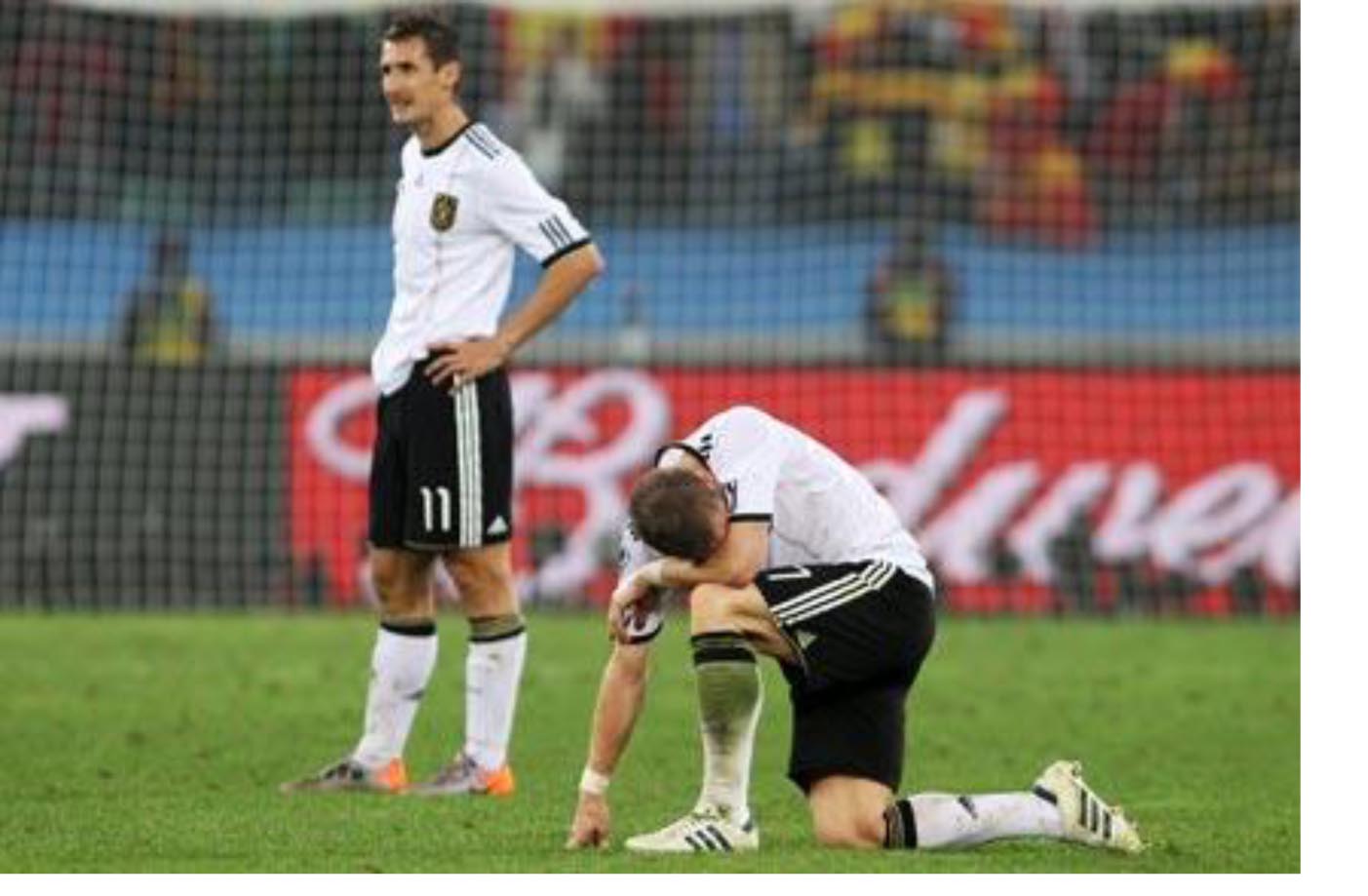

Naturally one question to arise is what to do when we fail. Do we succumb to the dismay and depression that result from failure?

Turning back to the World Cup. Germany and Uruguay both lost semi-final matches to their respective opponents. If you watch the games, or look at images of the players of these losing teams, it is obvious how crushing the losses were.

Both teams had come exceptionally close to the cup, only to miss the chance to participate in the final. The “consolation” match for third place between Germany and Uruguay started as one might expect – two teams that felt frustrated and depressed. The beginning of the game didn’t swell with the normal excitement or anticipation of other matches. In fact, it almost seemed to me that the teams would rather be on a plane headed home, than playing another match. However, not long into the game, everything changed. I can’t put my finger on the exact moment, but sometime in that first half both teams seem to forget about their recent pain, and started paying attention to the task at hand. In my opinion, the match turned out to be one of the most entertaining of the entire tournament. The skills of individual players and composite teams were astounding. The desire to win was rekindled, and the result was a courageous attempt to excel. Only when the players dismissed the agony of recent defeats were they able to meet their potential.


Likewise in life. Anything worth doing is worth our unbridled effort (D&C 4). Success and failure are transient. Failure should not consume us, but only be the motivation to improve.

I could go on about a number of other things, like the traditional exchanging of jerseys at the end of a game, or the professionalism of stopping play when a player is (really) injured. But I’ll stop here.

There is so much joy in the journey. The highs and lows of a game are what make it interesting. Without missed shots, saves, goals, and all the rest, it would just be a bunch of people aimlessly jogging around with their socks pulled high.

Monday, July 19, 2010

The Condemnation of Hunting for Sport

Utah allows the hunting of black bears, and is currently updating its bear management guidelines.  There is strong support for bear baiting, which is the practice of placing enticing food in a spot and waiting in hiding for the bear to wander up and then killing it.  How brave and heroic.  There are also multiple bear hunts during the year, including spring hunts where many mothers are killed, leaving newborn bear cubs orphaned and, essentially, dead as well.  Utah also allows the hunting of cougars, elk, deer, pronghorns, moose, Rocky Mountain goats, rabbits, bighorn sheep, bison, sandhill cranes, and a whole flock of different kinds of birds.  Have a thirst for killing?  Please come to Utah (although Utah certainly isn't alone in this regard).

Now, I don't have a problem with all kinds of hunting.  The Word of Wisdom gives us some helpful direction in this matter:
12 Yea, flesh also of beasts and of the fowls of the air, I, the Lord, have ordained for the use of man with thanksgiving; nevertheless they are to be used sparingly;

13 And it is pleasing unto me that they should not be used, only in times of winter, or of cold, or famine.

14 All grain is ordained for the use of man and of beasts, to be the staff of life, not only for man but for the beasts of the field, and the fowls of heaven, and all wild animals that run or creep on the earth;
15 And these hath God made for the use of man only in times of famine and excess of hunger.
Hunting for food is so ingrained in our culture, and essentially every culture on Earth, that I don't have any meaningful objections.  I also admit to eating my fair share of meat, meaning I can't point to hunters as violating the tenet that meat is really only to be used sparingly and in times of winter or famine without also indicting myself.  I am, however, trying to make a conscious effort to reduce my meat intake.

Unfortunately, a substantial amount of hunting that goes on here in Utah has nothing to do with procuring food and raiment, and thus must be condemned.  Do bear hunters eat the bear meat?  How about cougar hunters?  Do you think Sarah Palin is landing the helicopter to gather the succulent wolf meat after her aerial hunts?  How important to our society is the availability of moose and bison burgers?  What wine goes best with sandhill crane, do you suppose?

Tuesday, July 13, 2010

The Right Kind of Justice For Illegal Immigration

We've entered a new era of creepy in the Utah immigration debates.  A group of "Concerned Citizens," who cowardly chose to remain anonymous, quietly spied on Hispanics and compiled a list of 1,300 names of people they claim are illegal immigrants.  They listed names, birthdays, addresses, phone numbers, workplaces, Social Security Numbers, and due dates of women who are pregnant.  There is good evidence that the group had illegal access to private information through government databases.  Besides being creepy and despicable, and this should come as no surprise, the list is also inaccurate.

The most common trope about illegal immigration is that it is just that, illegal, and that we shouldn't allow any illegal activity in America to go unpunished.  Turning a blind eye to illegal immigration undermines the rule of law, cheapens our legal system, and threatens our security.  These conservatives want the illegals rounded up and shipped off.  Their rhetoric, unfortunately, usually goes beyond simply wanting the immigration laws enforced, it usually contains a level of vindictiveness and anger that is easily associated with racism and xenophobia.  It is unChristlike and unbecoming of members of our faith.  They want justice through punishment.

Friday, July 9, 2010

Global Warming House Cleaning

Two quick global warming related issues:

First, two reports were recently released exonerating the Climategate scientists.  One was released by the Netherlands Environmental Assessment Agency* and another by a special British investigation.  The scientists "didn't skew science to inflate evidence of man-made global warming," but were a little too secretive and acted like doofuses in some cases.  But the science is sound.  Should we expect apologies from all the people (I'm looking your way, Beck, Hannity, DeMint, et al) that smeared them in a political ploy to debunk the idea that humans are causing global warming thereby avoiding regulations on greenhouse gases?  Probably not.

Second, a large chunk of America is now suffering under a massive heat wave.  Can we assume that the skeptics will take this as evidence of global warming just as they take news of cold weather as evidence of its falsehood?  Again, probably not.

*On a side note, as a person of Dutch heritage with the most outrageous Dutch name you will ever encounter, let me just express my extreme pleasure with how the World Cup is unfolding.  Once David Villa gets a mouthful of Van Bommel's elbow and a thighful of his cleats, I expect Spain to fold and become as irrelevant in world soccer as they are in world politics.  Am I taking this too seriously?  Probably.  Hup!

Thursday, July 8, 2010

George Washington's Foreign Policy and the Middle East


Glenn Greenwald highlights, once again, the fundamental problem with America's current foreign policy towards the Middle East.  In an effort to combat extremism we have attacked and occupied Afghanistan and Iraq, committed torture, held supposed extremists in prison indefinitely without charges or hearings, and failed to push back against Israeli aggressions.  As a result, no surprise, we have likely created far more extremism than we have destroyed, we are likely less safe now than we were before 9/11, and we are certainly a bigger target.

After reading Greenwald I stumbled across the following (kind of long) passage from George Washington's farewell address regarding foreign policy:
Observe good faith and justice towards all nations; cultivate peace and harmony with all. Religion and morality enjoin this conduct; and can it be, that good policy does not equally enjoin it -- It will be worthy of a free, enlightened, and at no distant period, a great nation, to give to mankind the magnanimous and too novel example of a people always guided by an exalted justice and benevolence. Who can doubt that, in the course of time and things, the fruits of such a plan would richly repay any temporary advantages which might be lost by a steady adherence to it?. . .

Tuesday, June 22, 2010

Cancer, Healing, and the Meaning (Or Lack Thereof) of This Life

"Cancer" is one of the five worst words in the English language.  It sounds ugly.  It has ugly, death-ish connotations.  It evokes images of some alien life taking over one's body.  It has two c's that make different sounds, which is lame and annoying.  And when you learn that a young, healthy loved one has cancer it is so devastating.  You find yourself doing verbal somersaults to avoid saying the word out loud, as if by saying it you will make it worse.

So I recently had the occasion to give a loved one a priesthood blessing related to a cancer diagnosis, and as I've contemplated mortality and healing I've started having a lot of questions which I've never thought about before.  After that blessing I went and read Elder Oaks' talk from the most recent conference called "Healing the Sick".  The takeaway point, I think, is the following:
From all of this we learn that even the servants of the Lord, exercising His divine power in a circumstance where there is sufficient faith to be healed, cannot give a priesthood blessing that will cause a person to be healed if that healing is not the will of the Lord.

Wednesday, June 9, 2010

Religious Freedom and the Ground Zero Mosque

The Eleventh Article of Faith states: "We claim the privilege of worshiping Almighty God according to the dictates of our own conscience, and allow all men the same privilege, let them worship how, where, or what they may."

I stated in my last post that my evolving three pillars of Things I Care About The Most In Politics are peace, a healthy sustainable environment, and moral/religious agency.  I think if we safeguard these three things we can live in a pretty great world for a long time.  Of course the three are intimately intertwined.  War is usually based on scarcity of resources (the environmental aspect) or religious conflict.  If we could focus on cleaning up our religious conflicts and our environment, sustainable peace would surely follow.

Unfortunately, there are many right here in America who want to restrict the religious freedom of anyone that worships different than they do, thus creating more conflict and less peace.  The latest and most public incarnation of this bigotry is the uproar over the plans to build a mosque and Muslim information center a few blocks from ground zero.

The opponents of this mosque truly believe that those who died on 9/11 would be dishonored by the mere fact that Muslims would have a place of worship so near ground zero.  The only way this thinking makes sense is if you believe that all Muslims are responsible for the actions of al Qaeda and the extremist factions that want to harm the United States.  This is, of course, absurd and bigoted.

Monday, June 7, 2010

It's Probably Time For A Little More Optimism Around Here

In the latest iteration of how we treat our planet, we have now released probably between 50 to 100 million gallons of oil in the Gulf of Mexico, and we're probably only about halfway through the the release.

It is the sort of disaster that just makes you sick.  Birds and dolphins and fish are dying and people are losing their livelihoods.  We care so much about cheap energy that we are willing to downplay or ignore even the most heinous risks to get it.  Doing the hard things and making the hard decisions for our long-term good is not a particularly strong attribute for us, and the gulf oil spill is the perfect reminder of that fact.

And this applies to more than just the environment.  Israel and Palestine won't make the hard decisions in order to come to peace.  The same goes for many other nations, including America, which value short-term benefits and military force over long-term solutions and true and lasting peace. 

Tuesday, June 1, 2010

It's Time to Condemn Israel and Require More Concessions for Peace

What came first, the Palestinian terrorism, targeting of civilians, and suicide attacks on Israel chicken or the Israeli targeting of civilians and brutal oppression of Palestinians egg?

The latest escalation of the problem occurred over the weekend when Israeli commandos stormed a humanitarian aid ship headed for Palestine and killed at least ten civilians.  The ship was attempting to violate an Israeli embargo of Gaza.  This horrendous act is just Israel following the script, though.  The next few scenes will inevitably go something like this:  Palestinians will react to the killings at sea with protests and violence; Israel will react to Palestinian protests and violence by entrenching further, demolishing a few buildings, tightening their grip on Palestine and the decades-long embargo leading to even more soul-crushing poverty and desperation; Palestinians will resort to suicide bombings and terror; Israel will crush a Palestinian uprising.  The rest of the world will have some harsh critiques for the script but allow the play to go on.

* For some reason I'm having difficulties embedding the video, so go watch it on Youtube here.

Glenn Greenwald, of course, does a masterful job outlined just why this latest attack is so repulsive, and the inept handling of the situation by the Obama administration, which refuses to join countries like Russia, Turkey, Brazil, France, Spain, and China in condemning the attack.  This was a boat in international waters delivering badly needed food, medicine, and building materials to Palestinian civilians who live in abject poverty and under dictatorial oppression.  The United States must send a strong message that human rights and basic human decency are of paramount importance, more important than Israel's right to oppress the Palestinians, and condemn this act.

Tuesday, May 25, 2010

The Great Mormon Novel

I am going to wade into a conversation that occurred about a year ago but which was rekindled recently by an article in Slate that asked the question:  "Where is the Great Mormon Novel?"  The article was written as a critique of the new novel by Mormon Brady Udall called The Lonely Polygamist.

This article lead back to an article in the Mormon Times that stated that the Great Mormon Novel is impossible for impossibly shallow reasons thoroughly discredited here and here.  The gist was that Mormons are not self-critical enough and not willing to question beliefs enough to write great literature.  The discussion then turned a bit more meta with the proposition that we shouldn't even be worried about creating the Great Mormon Novel because the concept itself is outdated and unworthy of our attention.  This is my incredibly glib recap of the discussion and I encourage you to read through those links and flesh out the arguments for yourselves.  (As a side note, if you haven't spent some time exploring Mormon artistic endeavors at A Motley Vision and Dialogue, it is worth your time to do so.)

I think transcendent literature is something that is universal to our shared human experience.  What makes a piece of literature timeless is that it speaks to people from different backgrounds, cultures, eras, and genders, and can reveal something new to each.  My initial reaction, then, was that a Great Mormon Novel is not very likely, not because we aren't able or willing to question faith and authority and embrace ambiguity and conflict, but because we are pretty weird.  Pres. Hinckley, on several occasions, reiterated the words of the apostle Peter in referring to us as a "peculiar people."  We have always been encouraged to live apart from the world and embrace our peculiarity.

Wednesday, May 19, 2010

A Lean To The Right?

Bennett is out.

“When it was announced that Bennett had been eliminated from the race, a huge ovation swept through the convention hall and there were hoots and shouts of 'He's gone! He's gone!' Other delegates hugged and tea party members waved their yellow 'Do Not Tread On Me' flags.”

I am exceptionally curious about what, specifically, Bennett did that resulted in this level of vitriol. Even more, I am interested in what the Republican delegates see in Tim Bridgewater that has him as their nominee. If anybody out there has an answer better than “Bob Bennett was too liberal to represent Utah,” I would love to hear it.

My greatest fear is that democracy is slowly being smothered by popular media. Do “democrats” understand “liberal” policy? Do “republicans” truly agree with “conservative” ideology? Are “independents” and party swappers (and everyone else for that matter) simply opportunistic snakes, waiting for the chance to strike?

I don’t live in Utah, but I found a recent article from The Salt Lake Tribune that I felt brought up some excellent questions for conservatives. Naturally, one could make a similar, polarized list for “liberals”. What I struggle with is that the major gripe of the Tea Party movement is that the incumbents are not conservative enough, and as such, I thought it would be interesting to point out what “ultra-conservative” really means. Here are the ten questions from the recent article I cited above:

1. Do you oppose or support socialized medicine? If you answered "I oppose socialized medicine," will you introduce legislation to repeal Medicare for seniors -- socialized medicine brought to us by Great Society liberal Lyndon Johnson? If not, explain why you support socialized medicine for seniors and but do not support Obamacare for working families.

2. Will you introduce legislation to repeal all agriculture, grazing and mining subsidies? If not, please explain why you support socialized agriculture, grazing and mining.

3. Will you introduce legislation to sell off all federal lands in Utah to the highest bidder? If not, please explain why you think the big federal government, not the private sector and private landholders, should own Utah's lands. (Note, giving the land to the State of Utah just transfers the socialism to a different level of government, so that is not a valid answer).

4. A major criticism of Sen. Bennett was his support of the TARP in 2008. Will you pledge to oppose all government bailouts, even if that means a freezing of the credit markets and the failure of small businesses across the United States?

5. Which federal regulatory agencies will you eliminate? The Securities and Exchange Commission? The FDIC? The Consumer Product Safety Commission? The Federal Mine Safety Administration? The Environmental Protection Agency? The Agricultural Inspection Service? The Food and Drug Administration? If you support these agencies, please explain why we need big government in these areas, none of which are expressly provided for in the U.S. Constitution.

6. Do you support repealing the Small Business Administration? If not, please explain why you think big government bureaucrats know better than the free market which small businesses deserve help and support (and what a bureaucrat could possibly do to help a free market capitalist business person).

7. Do you support the National Weather Service? If so, please explain why big government can track the weather better than the private sector.

8. Will you oppose all appropriations earmarks for Utah?

9. Will you pledge to oppose government interventions to bring jobs to Utah? If not, please explain why you think you, and not the market, should determine where jobs are located in the United States.

10. Will you introduce legislation to repeal the Federal Communications Commission and the work of its nanny state, liberal, politically correct bureaucrats who regulate the words people can say on the television and radio and the images shown on TV? Or do you think bureaucrats, not the free market, should decide what is appropriate to air in America?

I’m sincerely curious about people’s responses to these questions. I will never suggest that a party member must adhere to all of said parties’ ideology; however, considering the cry that the GOP needs to be more conservative, I wonder how many people out there are ready for what that really means. Comments?

Wednesday, May 12, 2010

Moderation In A Crowded World

In 1800 just after the United States was formed and the Constitution ratified, the world population was about 978 million, just under 1 billion.  North America had about 7 million people.  If you had suggested to them at the time that they really should consider moderating consumption and conserving natural ecosystems, they probably would have laughed you to scorn.  "The world has more natural resources and available land than we ever could possibly develop," they would say to you with a condescending chuckle.  "Why on Earth should moderate anything?"

Today the world population is approaching 7 billion and North America has about 340 million people.  In a hundred years we'll be pushing 10 billion people.  It is a crowded world we live in now and it is not difficult to imagine running out of oil, chopping down the Amazon rain forest, and polluting our entire atmosphere and oceans to near sterility.  For thousands of years leading up to now humans have never had to moderate because the world was so big and we were so small.  So it is not altogether surprising, then, when so many people today, Americans in particular, continue to scoff at the idea of moderation, at the idea that we have to pull back in order to preserve what we have.

The oil gushing into the Gulf Coast at a rate of 210,000 gallons a day, which we are apparently powerless to stop any time soon, is a fitting example of how we are failing to be proper stewards of the Earth because we are not willing to moderate our thirst for oil.

But the idea of moderation in an ever more crowded world doesn't just pertain to the environment and consumption of goods.